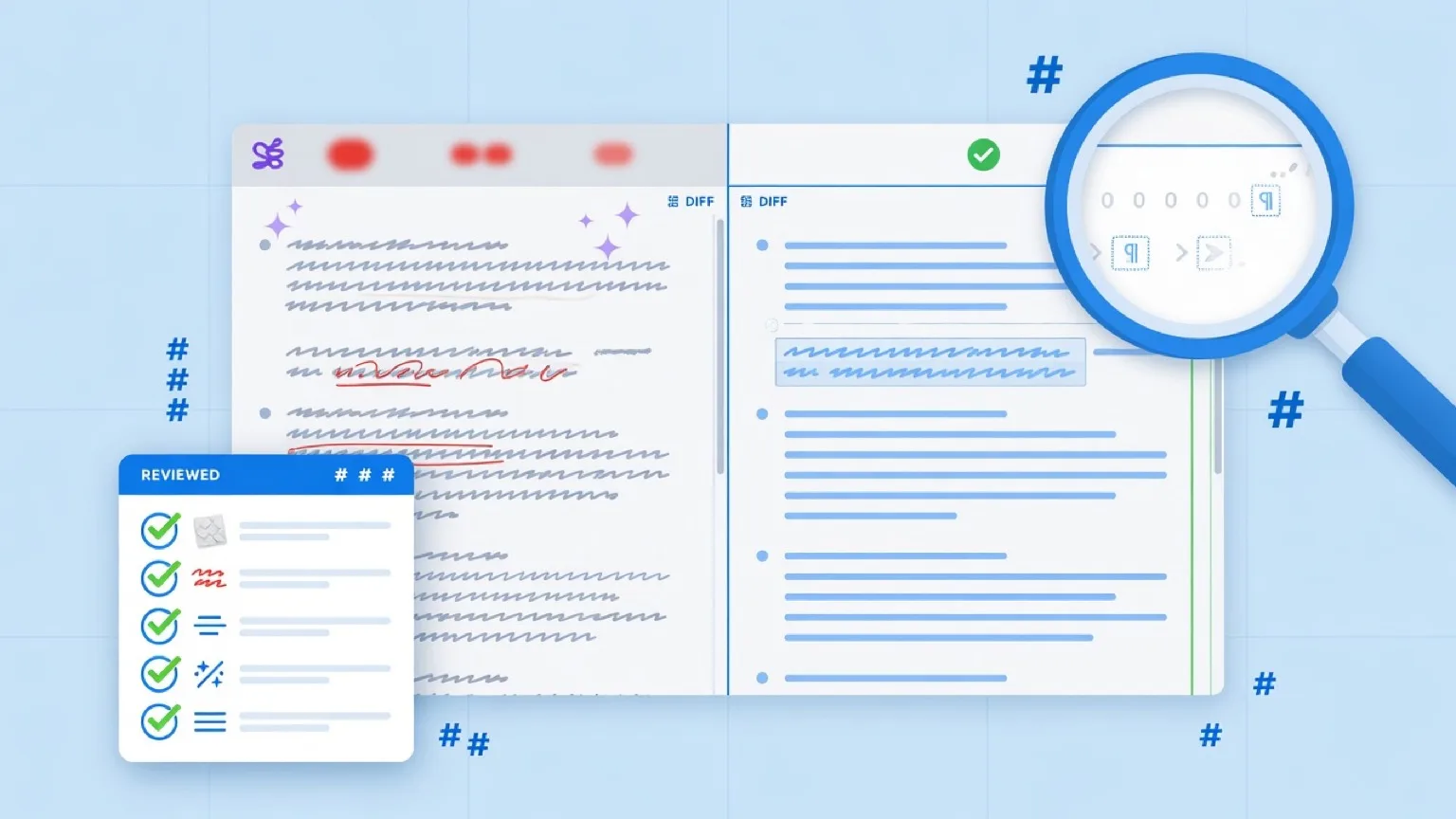
Cleaning AI-generated text sounds simple until the text contains invisible Unicode, Markdown syntax, links, citations, numbers, quotations, or multilingual passages. A tool may produce cleaner-looking output while also changing details you never intended to modify.
That is why cleanup should begin with an acceptance rule, not a button.
A cleaning pass is trustworthy only when an editor can verify what changed, what remained intact, and when an operation crossed from sanitation into rewriting.
The practical challenge is verifying that a completed cleaning pass changed only authorized material. Treat cleanup as a controlled transformation with a defined scope, a visible diff, and a final editorial decision.
The AI Output Cleaner separates deterministic cleanup from generative rewriting. Its free Invisible Characters and Markdown tools run locally in your browser. The Text Watermark Remover follows a different path and requires a distinct review standard.
Define allowed changes before cleaning
Do not start by asking, “Does the result look better?” Start by asking, “What is this operation allowed to modify?”
An allowed-change specification can be concise. For example:
- Remove identified unwanted Unicode residue.
- Replace a specific spacing character with a standard space where appropriate.
- Strip Markdown markers while preserving readable text and any structure the destination still requires.
- Preserve all wording, names, figures, dates, URLs, citations, and quoted passages exactly.
This specification provides a concrete baseline for verification. Without it, polished output can conceal unauthorized changes.
The narrower the intended operation, the stricter the comparison must be. In deterministic sanitation, an unexpected synonym, reordered phrase, merged sentence, or altered number is not an improvement. It is a failure of scope.
Formatting changes are not semantic edits
Formatting and meaning operate at different layers, but their boundary is not always obvious.
Removing a Markdown heading marker from ## Results leaves the word “Results” intact. Replacing repeated spaces with a single space preserves the underlying sentence. Removing zero-width residue from the middle of a word leaves visible text unchanged.
By contrast, changing “may” to “will,” replacing a colon with a period, combining two sentences, or converting a list into a paragraph can alter emphasis, logic, or interpretation. These modifications are not safe simply because the output looks cleaner.
A deterministic cleaning pass must avoid editorial interpretation. It should apply explicit transformations to defined targets without adjusting tone, simplifying vocabulary, strengthening claims, correcting reasoning, or smoothing prose unless rewriting was explicitly requested.
This distinction is critical whenever a subtle wording change creates a different claim.
Protect numbers, names, URLs, citations, and quoted text
Certain fields are fragile because a single-character change can invalidate them. Always protect at least the following categories:
- Personal names, company names, product names, and model designations.
- Prices, percentages, measurements, version numbers, dates, and time ranges.
- Full URLs, email addresses, file paths, identifiers, and tracking parameters.
- Footnote markers, bracketed citations, reference numbers, and source labels.
- Text within quotation marks or inline code spans.
Do not assume a cleaning tool automatically protects every field. Establish a baseline before cleaning, then verify critical strings after processing.
For URLs, compare the complete destination target, not just visible anchor text. For figures, compare digits, signs, decimal separators, units, and qualifiers. “About 5%,” “5%,” and “more than 5%” represent distinct factual claims.
For quotations, preserve source wording exactly unless the source text itself is being corrected. A cleanup pass must not silently regularize, paraphrase, or adjust quoted material.
Audit invisible Unicode as text, not as proof of AI
Invisible or unusual Unicode characters are properties of text. They do not prove who wrote a passage, which model generated it, or whether the content contains a statistical watermark.
An actionable audit identifies the character, code point, location, and frequency. The editorial decision follows.
The Invisible Characters workflow provides deterministic inspection and cleanup. Treat its findings as technical evidence of character composition rather than a verdict on AI authorship.
A code point can be unusual without being an AI watermark
An unfamiliar code point may stem from accidental residue, copied typography, language-specific formatting, or intentional styling.
For instance, U+202F (narrow no-break space) appears in standard typography where a thin space must prevent line breaks. Its presence alone does not establish that an AI system inserted a watermark.
A rare character is not automatically malicious or unnecessary, and a clean scan does not prove the absence of other watermark types.
Context is essential. Determine where the character appears, what purpose it serves, whether destination systems support it, and the impact of deleting or replacing it.
Deleting, replacing, or keeping characters are distinct editorial decisions
Character cleanup is not a uniform action. Each finding requires one of three distinct decisions:
Delete when the character serves no intended purpose and its removal correctly joins surrounding text.
Replace when the character serves a meaningful separator or spacing role that the destination requires in a more compatible format.
Leave intact when required for language rules, typography, emoji composition, bidirectional display, or other valid technical functions.
These actions are not interchangeable. Deletion can accidentally merge words, while replacement can corrupt words or emoji sequences. Unwanted residue can also impair search indexing, copying, and schema validation.
Avoid universal handling assumptions for code points without a verified rule matrix. Inspect findings, define target treatments, execute changes, and verify output against source text.
Treat Markdown as visible syntax
Under CommonMark specifications, Markdown is plain-text syntax for structured documents. Its markers are visible characters in source text, even when renderers display them as headings, lists, emphasis, links, or code blocks.
While Markdown syntax is visible, removing it can discard structure required by destination platforms.
Removing syntax is distinct from rewriting prose
Removing ** from **Important** does not alter the underlying word. Stripping a leading # from a heading preserves the heading text. Removing backticks from code labels retains inner characters intact.
However, Markdown conveys structural meaning. Links pair anchor text with destinations. Lists define structural boundaries. Blockquotes designate citations or quotations. Code blocks preserve whitespace and prevent interpretation as prose.
Use the Markdown path with explicit destination requirements. Stripping Markdown requires clear rules for headings, bullets, links, tables, code blocks, and line breaks.
If converting a Markdown link drops the destination URL and retains only anchor text, the missing link violates standard preservation rules. Retain the URL or reject the transformation.
Determine required destination structure
Plain-text fields, CMS editors, spreadsheet cells, email clients, and code comments enforce different structural constraints.
Before stripping Markdown, define the target output format:
- Should headings remain on dedicated lines?
- Should bullet points convert to plain lines, numbered lists, or standard sentences?
- Should emphasis markers drop without replacement?
- Should link URLs remain visible inline?
- Should blockquotes preserve attribution indicators?
- Should code blocks remain untouched?
- Should table rows flatten, delimit with punctuation, or retain tabular structure?
Transformations remain non-editorial when wording is preserved and structural conversion follows defined rules. An operation becomes a rewrite when it reorganizes arguments, merges items, paraphrases labels, or selectively omits details.
Verify the output state
Verification is the critical stage of the workflow. Cleaned output cannot be trusted simply because an automated operation completed without errors.
Retain the original text, generate a diff, and inspect both expected and unexpected changes. The objective is not to assess visual polish, but to verify that every modification matches authorized parameters.
Use a structured acceptance record:
| Field | What to record |
|---|---|
| Original text | Exact source text before processing |
| Expected allowed changes | Characters or syntax authorized for modification |
| Actual changes | Character-level or word-level diff |
| Semantic effect | Any impact on wording, facts, structure, or meaning |
| Decision | Pass, revise, or reject |
This framework applies to individual paragraphs and full documents while enforcing strict change boundaries.
Verify wording and sentence counts for deterministic cleanup
For Invisible Characters and Markdown cleanup, begin with a literal comparison.
A word-level diff must reflect only expected residue removal or syntax conversion. If standard words are added, modified, or omitted, halt and review the diff. Never dismiss discrepancies because a sentence appears to mean the same thing.
Sentence counts serve as an early warning indicator. If a deterministic pass intended only to strip invisible characters reduces sentence count from eight to seven, investigate immediately. A modified punctuation mark, unintended merge, or line-break rule may have altered the structure.
Sentence counting can be skewed by abbreviations, decimals, initials, or code snippets. Use it as an indicator alongside direct diff inspections.
Verify paragraph ordering, item counts, headings, and line boundaries whenever structural alignment matters. Deterministic cleanup must produce a predictable diff.
Audit protected names, figures, dates, URLs, citations, and quotes
Perform a targeted check on protected fields even when general diffs look clean.
Confirm that proper names retain exact spelling and casing. Validate numerical figures against source data, including associated units and qualifiers. Check dates completely to ensure day, month, year, or duration ranges have not shifted.
Verify URLs character by character. Missing query strings, modified paths, or altered punctuation can break destination links.
Treat citations as precise references rather than decorative text. Identifiers such as [7], (Smith, 2025), DOIs, and footnote markers link copy directly to evidence. Renumbering or dropping citations breaks source attribution.
Inspect quoted passages exactly. If an operation modifies a quotation, flag the change separately and require explicit editorial authorization.
Review Unicode-sensitive text, emoji, and multilingual copy
Universal rules like “strip all invisible characters” can corrupt specialized text.
Zero-width joiners (ZWJ) and zero-width non-joiners (ZWNJ) serve legitimate linguistic and technical functions. ZWJs form standard emoji sequences, while both characters govern script shaping and word structure in multiple languages. Indiscriminate removal breaks rendering, readability, and meaning.
Multilingual content requires visual and linguistic validation. Check font rendering, bidirectional text flow, combining diacritics, and word-wrap boundaries.
Unicode normalization can generate alternative code-point sequences that render identically. While acceptable under a declared normalization policy, these are still technical changes. Record them in the audit trail and verify compatibility with downstream systems.
Emoji require equal precision. A single displayed glyph often combines multiple code points; stripping hidden components can alter the visual icon or display broken fallback characters.
Identify when cleanup becomes rewriting
Cleanup transitions into rewriting whenever an operation modifies vocabulary, syntax, sentence structure, tone, emphasis, or narrative flow.
Synonym substitutions, sentence splitting or merging, paraphrasing, fluency adjustments, and paragraph restructuring belong to generative or editorial rewriting workflows. While they may preserve underlying intent, they are not deterministic sanitation.
When this line is crossed, transition from deterministic acceptance checks to a full editorial review. Evaluate the output for factual consistency, omissions, unauthorized additions, and altered implications.
Claude’s 2026 watermark requires distinct verification
Claude’s 2026 watermark involves statistical patterns in token sampling rather than unusual Unicode characters, zero-width residue, or Markdown syntax.
This distinction requires different evaluation methods and verification evidence.
Character audits do not inspect Anthropic sampling watermarks
A Unicode audit identifies formatting residue and specific characters present in text. It cannot detect or evaluate statistical token-selection patterns associated with Anthropic watermarks.
Consequently:
- Removing invisible characters does not demonstrate removal of Claude's statistical watermark.
- A clean Unicode scan does not confirm that text is free from AI watermarking.
- A character-residue scanner is not an official Anthropic watermark detector.
- Free deterministic cleanup tools must not be characterized as removing Claude's official watermark.
The residue checker on this site detects Unicode and syntax formatting artifacts. It does not output probability metrics and cannot evaluate official statistical watermarks.
The Pro Text Watermark Remover uses a separate meaning-preserving reconstruction workflow. Because this process modifies vocabulary and sentence structure, evaluate it as an editorial rewrite rather than deterministic sanitation.
No current public benchmark permits official detection claims
Anthropic's official detection interface is not yet publicly available. No public benchmark currently allows third-party services to claim verified clearance by an official Anthropic detector.
While Anthropic notes that revising phrasing throughout a document disrupts statistical sampling patterns, broad guidance does not prove that a specific third-party tool eliminates watermarks entirely, nor does it support 100% removal guarantees.
Editorial standards must reflect these technical realities. Evaluate Pro output for accurate meaning, verified facts, link integrity, correct figures, exact quotations, and absence of unsupported claims. Treat claims regarding statistical watermark clearance as unverified until validated against official detection tools.
Editorial acceptance checklist
Before approving cleaned copy, verify all five criteria:
- Core meaning remains intact. All claims, conditions, qualifiers, certainty levels, and relationships match the source.
- Facts and figures align with source data. Names, metrics, dates, units, identifiers, and factual statements are preserved exactly.
- URLs and citations remain functional. Link destinations, anchor text, reference indices, quotes, and attribution chains are maintained.
- Only authorized residue or syntax was modified. Every deterministic change falls strictly within the pre-approved scope.
- Generative rewrites are audited separately. Any generative pass is labeled, reviewed, and accepted under semantic preservation standards rather than treated as standard cleanup.
Base final approval on diff verification rather than surface fluency. Polished prose can introduce factual drift, while strictly faithful text may retain rough edges.
A dependable workflow keeps these concerns separate: define allowable edits, process the text, audit the diff, protect sensitive entities, and treat any wording adjustment as a rewrite. This turns text cleanup from an unverified cosmetic edit into a reliable, auditable editorial workflow.