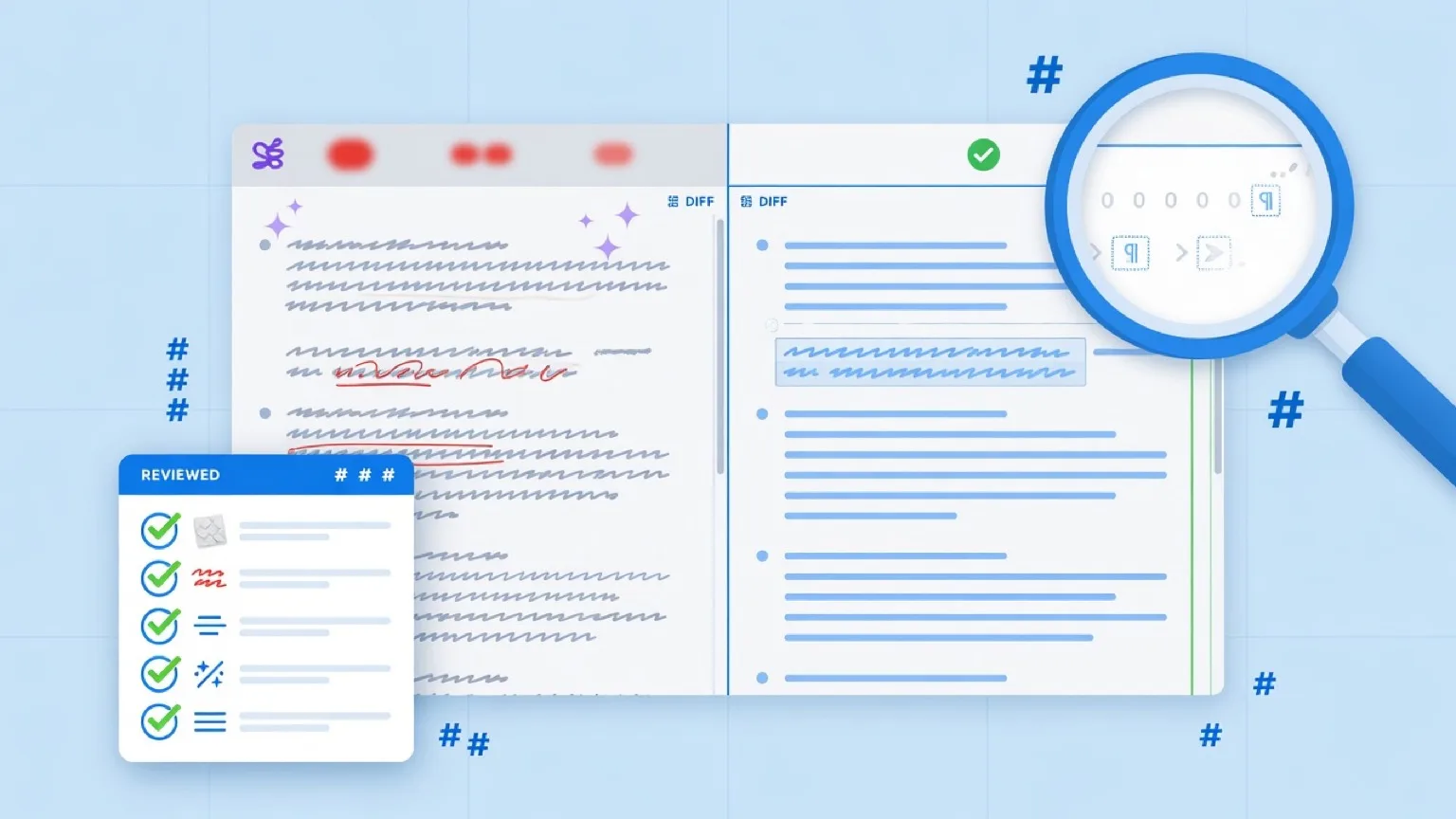
When pasting copied copy into content management systems and plain-text editors, writers and editors often run into strange cursor jumps, layout misalignment, and unexpected parsing failures. These subtle formatting glitches frequently stem from invisible characters transferred during rich-text copy and paste operations across different editing environments. Removing these hidden characters easily restores normal text layout and eliminates document parser warnings, but editorial teams often wonder whether deleting these characters alters underlying provenance, watermarks, or origin indicators.
The direct boundary is straightforward: removing invisible characters changes the raw byte sequence of a document and can alter how downstream tokenizers split words, but character-level sanitization neither removes statistical watermarks nor resolves questions of text authorship. Text cleanup is a mechanical fix for parser stability, not a mechanism for resetting provenance or bypassing attribution systems. Editorial workflows must separate visual formatting repairs from the cryptographic and statistical frameworks used to evaluate content origin.
Understanding this distinction begins with how modern text standards handle invisible characters. Under the Unicode 17 specification, variation selectors are defined as default-ignorable characters that do not display standalone glyphs on their own but perform legitimate glyph-selection and rendering functions across various scripts and digital display environments. Because these code points carry no visual width, standard text editors display them as blank space or hide them entirely, making accidental clipboard residue look identical to functional typographic controls.
Hidden Characters Versus Statistical Watermarks
A common misconception among content editors is that machine-generated text signals rely on injected zero-width spaces or hidden Unicode markers. In practice, modern generative watermarking operates within the probability space of language models rather than through character-level injection. As demonstrated in research presented at ICML 2023 by Kirchenbauer and colleagues, statistical watermarking alters token selection during text generation by softly promoting a randomized green token set at each generation step. Detectors evaluate whether the resulting token choices follow this specific statistical distribution, identifying watermarked content without inserting any hidden Unicode code points.
Production-scale implementations follow this exact mathematical paradigm rather than relying on invisible text artifacts. For example, SynthID-Text modifies token sampling distributions during text generation and underwent evaluation across nearly 20 million responses. Because this mechanism embeds detection signals directly into the natural selection and frequency of standard vocabulary words, deleting zero-width characters or stripping formatting tags leaves the underlying statistical pattern intact. Editors cannot eliminate or verify such mathematical signatures by simply running text sanitization scripts.
Cryptographic Provenance and Structured Text Wrappers
While statistical watermarks do not rely on invisible characters, certain structured provenance protocols deliberately use specific invisible code points to transport signed metadata envelopes within plain text. The C2PA 2.4 specification outlines an optional manifest wrapper known as C2PATextManifestWrapper, which encodes signed manifest data into unstructured text streams using variation selectors U+FE00–U+FE0F and U+E0100–U+E01EF following an initial U+FEFF prefix and an NFC normalized content hash. In these specialized architectures, invisible code points represent an intentional data payload rather than accidental clipboard clutter.
Even when cryptographic metadata is present, its validation scope remains strictly technical rather than editorial. The C2PA 2.4 trust model verifies signed assertions, signer identity certificates, and tamper-evident bindings to the text asset, but the standard explicitly states that it makes no value judgments regarding whether the asserted provenance information is accurate or good. Consequently, preserving or stripping a signed wrapper alters cryptographic verification of the file history, but it neither proves nor disproves the factual authenticity of the underlying prose.
Classifiers, Watermarks, and Transparency Frameworks
Post-hoc automated detectors that inspect completed text files operate on entirely different principles than watermarks or provenance wrappers. Rather than checking cryptographic hashes or token sampling rules, heuristic classifiers analyze surface text features to predict likelihood scores. These statistical predictions carry inherent error margins and can shift unpredictably when text formatting or token boundaries change. For instance, OpenAI documented 26% true positives and 9% false positives on its English challenge set when testing its early AI text classifier, advised users that the classifier should never serve as a primary decision tool, and retired the system on 2023-07-20 due to low accuracy.
To bring clarity to these overlapping technologies, technical standards establish clear functional divisions among digital content transparency mechanisms. The NIST AI 100-4 publication provides a structured analysis of digital content transparency, dividing technical solutions into provenance tracking, watermark and metadata detection, automated content-based detection, and human-facing labels. The NIST AI 100-4 report explains that no single approach is sufficient on its own to resolve all transparency and verification challenges, emphasizing that each method addresses a distinct operational layer.
Practical Diagnostic Workflow and Editorial Boundaries
Editorial teams should establish a clear, evidence-bounded diagnostic workflow when managing clipboard anomalies and invisible text residue. When text pasted from web pages creates cursor lags, invalid line breaks, or syntax errors in build pipelines, editors should inspect and strip extraneous zero-width residue to stabilize rendering. However, teams must refrain from treating character sanitization as an audit of origin, an anti-plagiarism measure, or a method for altering machine attribution.
By maintaining strict boundaries between typographic maintenance and provenance evaluation, publishers ensure predictable document rendering without making unfounded assumptions about content origin. Character sanitization resolves local parsing friction, while questions of authenticity, authorship, and attribution remain governed by editorial oversight, verified source material, and cryptographic transparency standards.
Sources
- Unicode 17.0.0 Core Specification, Chapter 23
- A Watermark for Large Language Models
- Scalable watermarking for identifying large language model outputs
- Content Credentials: C2PA Technical Specification 2.4, Appendix A.8
- Content Credentials: C2PA Technical Specification 2.4, Scope
- Reducing Risks Posed by Synthetic Content: An Overview of Technical Approaches to Digital Content Transparency
- New AI classifier for indicating AI-written text